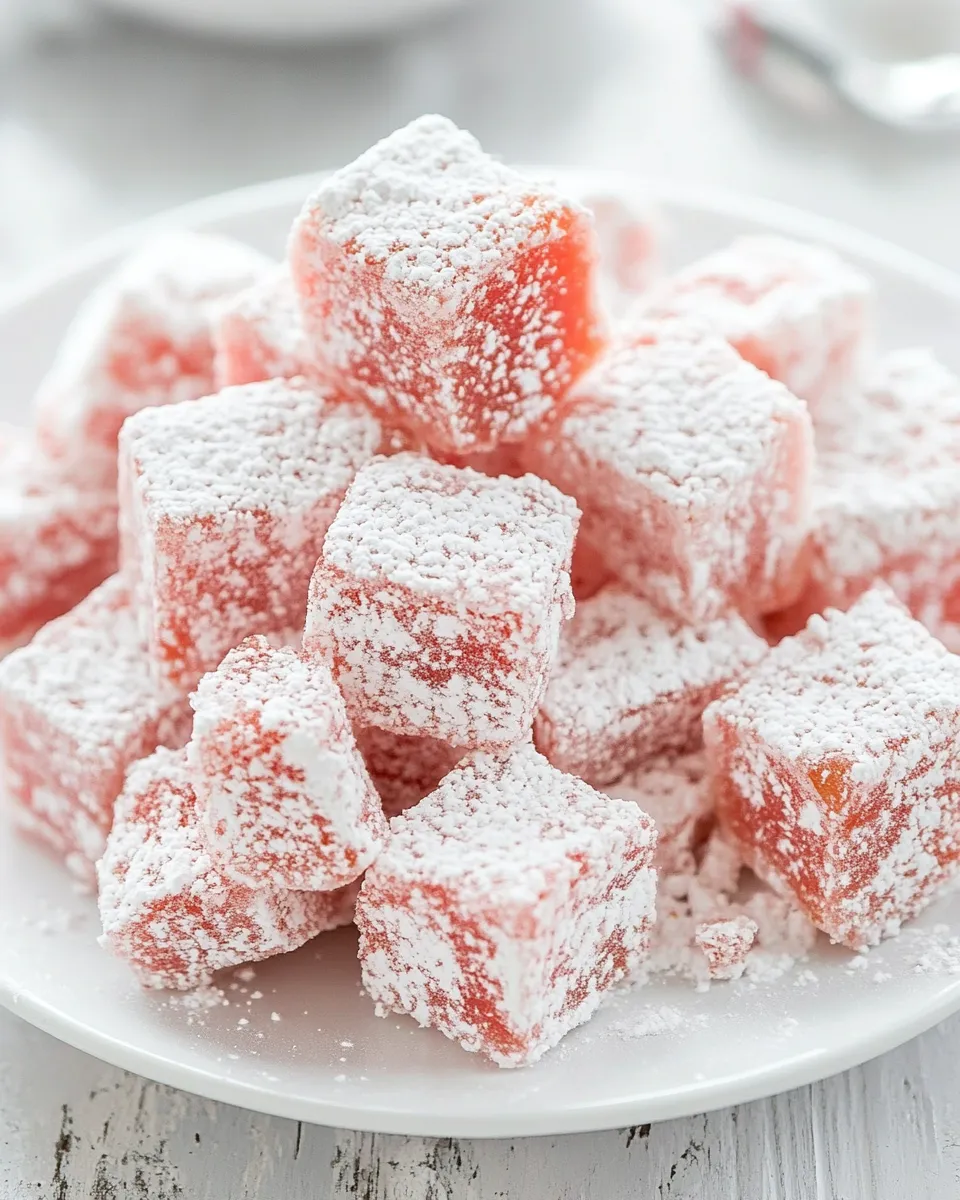
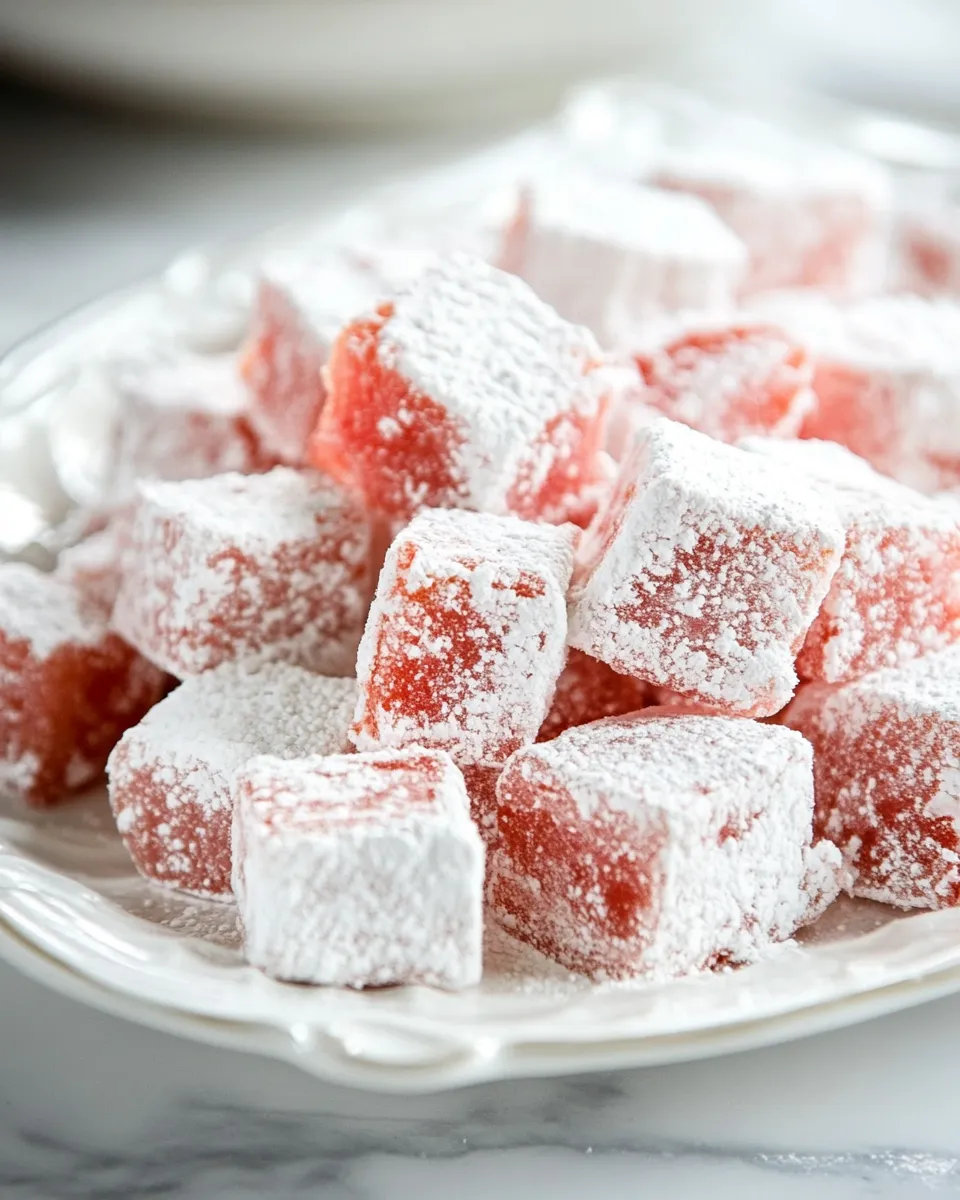
Turkish delight — soft, fragrant little cubes of jelly dusted in powdered sugar — is one of those treats that feels like a small celebration in every bite. I fell in love with lokum years ago on a damp afternoon in Istanbul, when a shopkeeper handed me a pink, pistachio-studded piece and smiled. That first taste was floral, slightly tart, and perfectly tender. It’s a candy that asks for patience and rewards you with texture and nuance.
In this recipe I’ll walk you through the exact method I use at home. It’s practical, no-nonsense, and faithful to a reliable technique: sugar syrup cooked to the soft-ball stage poured into a cornstarch base, flavored gently and set until firm. You don’t need special skills, just attention to temperature and stirring. The result is Turkish Delight with a clean flavor and a melt-in-the-mouth finish.
I’ll also cover what to buy, substitutions that work, the tools that matter, and the small mistakes that turn a silk-soft lokum into a chewy mess. If you want to make an impressive batch for guests or a comforting tray to nibble on, this is the version I return to again and again.
What to Buy
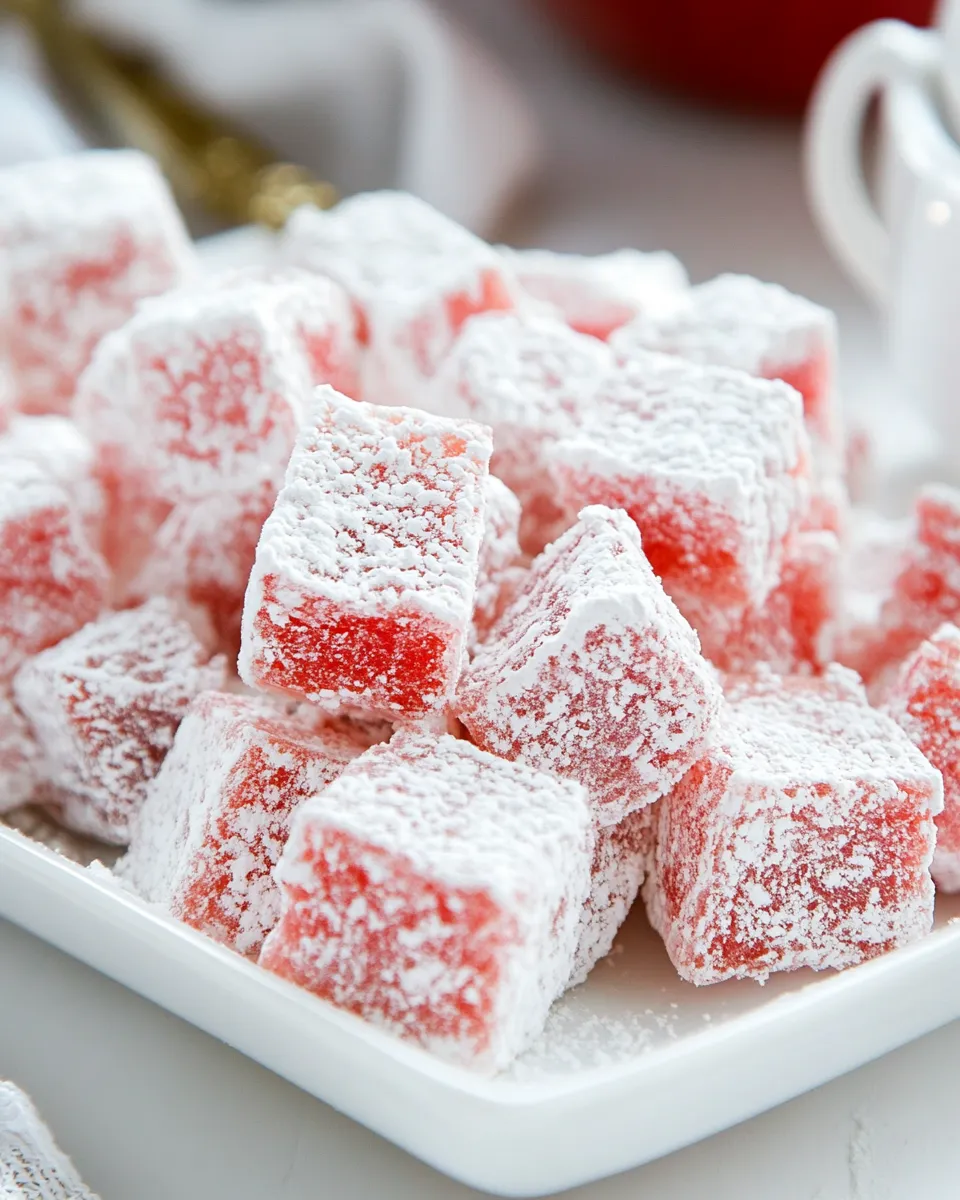
Buy quality extracts and rosewater if you want authentic notes; cheap flavorings can taste synthetic. A reliable candy thermometer and cornstarch are essential. Pick unsalted pistachios if you plan to use them — their natural sweetness and color are worth it.
Ingredients
- 4 cups granulated sugar — supplies the syrup base and structure for the candy.
- 4 1/4 cups water, divided — used for both the syrup and the cornstarch paste; keep it measured and separated.
- 3 tablespoons lemon juice — helps prevent crystallization in the sugar syrup.
- 1 1/4 cups cornstarch — thickens the mixture into a jelly; critical for texture.
- 1 teaspoon cream of tartar — stabilizes the syrup and improves chewiness.
- 2 tablespoons rosewater (optional) — classic floral note; use sparingly to avoid overpowering.
- 1 1/2 teaspoons raspberry extract — provides fruity lift and color when combined with red food coloring.
- 1 1/2 teaspoons orange extract — adds bright citrus depth to the flavor profile.
- 1/2 teaspoon salt — balances the sweetness and rounds flavors.
- 1/4 cup chopped pistachios (optional) — for texture and a nutty accent; add to the mixture or layer for visual interest.
- 1 cup powdered sugar — for coating the finished pieces so they don’t stick.
- 4–6 drops red food coloring (optional) — gives the candy a classic pink/red hue; use only if you want color.
Build Turkish Delight Step by Step
- Prepare a 9 x 9 inch baking dish by lining it with foil and spraying the foil with nonstick cooking spray; set the dish aside. Set two large (4–6 quart) stock pots on the stovetop. Clip a candy thermometer to one pot.
- In the pot with the thermometer, combine 4 cups granulated sugar and 1 1/2 cups of the water. Place over high heat and bring to a boil, stirring only to dissolve the sugar initially.
- In the second pot, pour the remaining 2 3/4 cups water. Whisk in 3 tablespoons lemon juice, 1 1/4 cups cornstarch, and 1 teaspoon cream of tartar until completely smooth with no lumps.
- Place the second pot over high heat and whisk continuously until the cornstarch mixture becomes a thick, smooth, white paste that holds its shape (it will look like a dense, petroleum-jelly–like paste). Keep whisking to avoid lumps.
- Return your attention to the sugar syrup and continue boiling it until the candy thermometer reaches 240°F (soft-ball stage).
- When the syrup reaches 240°F, carefully and slowly pour the hot syrup into the cornstarch paste a little at a time while whisking or stirring constantly to prevent lumps. Pouring slowly and steady stirring is safer and helps incorporate the syrup smoothly.
- After all the syrup is incorporated, set the heat to medium and simmer the mixture, stirring occasionally, for about 45 minutes. The mixture should thicken and turn a golden‑orange, jelly-like consistency.
- Turn off the heat. Stir in 2 tablespoons rosewater (optional), 1 1/2 teaspoons raspberry extract, 1 1/2 teaspoons orange extract, and 1/2 teaspoon salt. Add 4–6 drops red food coloring (optional) if you want a pink/red color; stir until evenly distributed.
- Pour about half of the hot mixture into the prepared 9 x 9 inch baking dish. If using, quickly sprinkle 1/4 cup chopped pistachios evenly over the poured half.
- Immediately pour the remaining mixture over the top so it levels and covers the pistachios before the candy cools and thickens. If you prefer, you may stir the 1/4 cup chopped pistachios into the full mixture and pour it all at once instead of layering.
- Refrigerate the dish for 30–60 minutes, until the Turkish delight is firm to the touch.
- Line the empty baking dish (or a clean work surface) with the 1 cup powdered sugar. Turn the chilled Turkish delight out of the dish and peel off the foil.
- Using a sharp knife or kitchen shears, cut the candy into approximately 100 small squares. As you cut, toss or shake each piece in the powdered sugar to coat all sides; you can also dust the knife with powdered sugar between cuts to reduce sticking.
- Store the coated pieces in an airtight container at room temperature. The candy will be somewhat firm after chilling and will soften slightly as it sits at room temperature.
Why It’s My Go-To
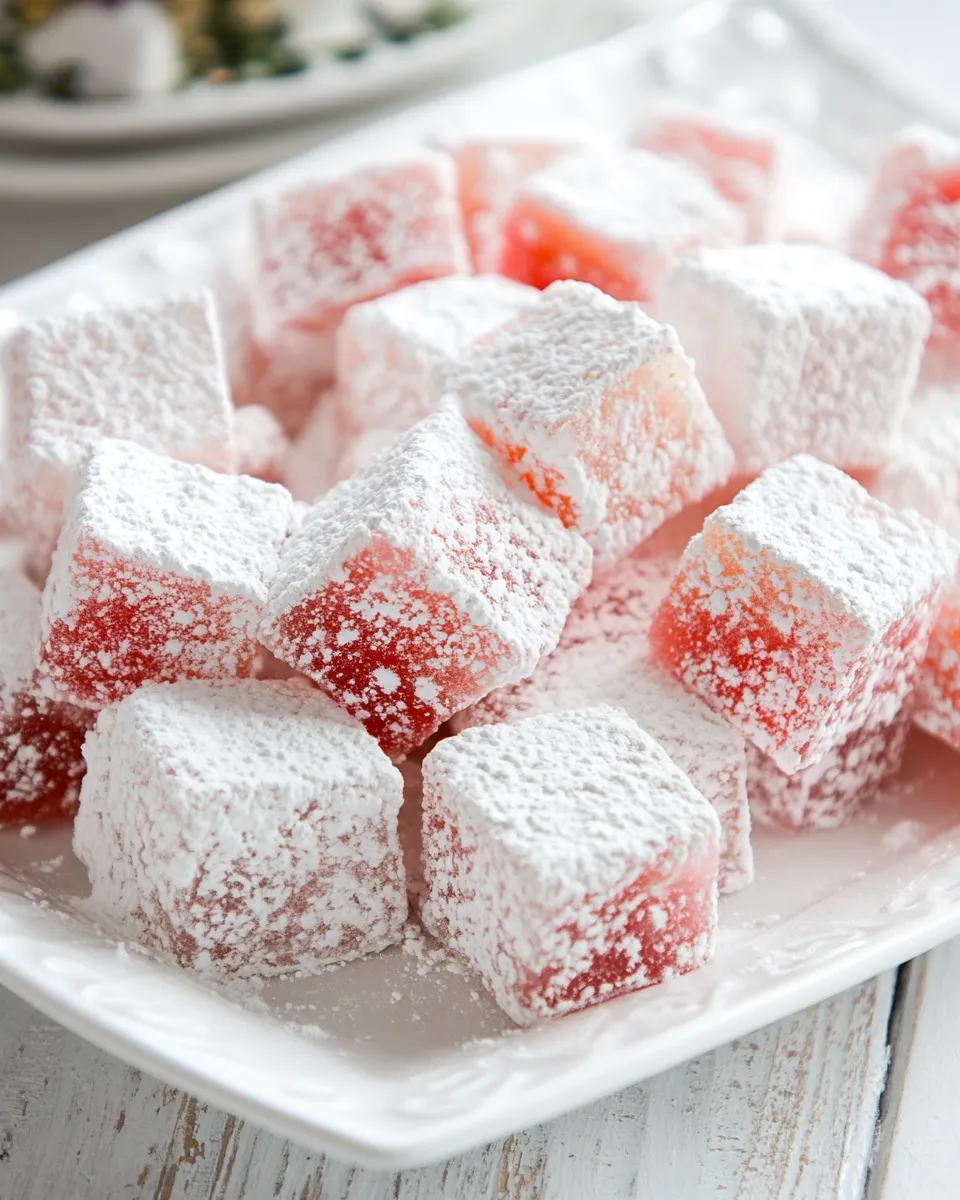
This recipe delivers consistent texture and an approachable flavor profile. The cornstarch base creates that classic, yielding chew without grit. I love how the raspberry and orange extracts combine to make the candy bright rather than cloying, while rosewater adds a whisper of tradition if you use it. It’s flexible: you can stud it with nuts or leave it plain, color it, or keep it natural.
It’s also forgiving in portions. You can make a full 9 x 9 pan and store it at room temperature for gifting or snacking over a week. The steps focus on technique rather than perfection of tools — if you follow the thermometer and whisking instructions, you’ll get a reliably pleasant lokum every time.
Ingredient Swaps & Substitutions
Keep quantities the same if you want the same texture. A few notes if you must swap:
- Rosewater — optional but authentic. If you don’t have it, omit it; don’t replace with another floral unless you know its strength.
- Raspberry and orange extracts — provide concentrated flavor. You can use 100% natural extracts or flavor oils designed for candy. Avoid using fresh fruit juices; they change water content and acidity.
- Cornstarch — essential. No direct substitute gives the same smooth, translucent texture. Potato starch or tapioca starch will not behave the same here.
- Pistachios — any chopped nut will work for texture, but toasted nuts will add flavor. Keep quantity at 1/4 cup if you want the same balance.
- Food coloring — purely optional. If you prefer natural color, a tiny amount of beet powder can tint, but it may introduce flavor.
Equipment & Tools
- 9 x 9 inch baking dish — for setting the Turkish Delight to an even thickness.
- Foil and nonstick spray — for easy unmolding.
- Two large (4–6 quart) stock pots — one for the syrup, one for the cornstarch paste.
- Candy thermometer — indispensable; you need to reach 240°F (soft-ball stage).
- Whisk and sturdy spoon — continuous whisking prevents lumps in the cornstarch paste; a spoon helps stir the thicker mixture.
- Sharp knife or kitchen shears — cut clean squares; dust blade with powdered sugar between cuts.
- Measuring cups and spoons — accurate liquid and dry measures matter for texture.
Mistakes That Ruin Turkish Delight
Several small errors will wreck the texture or flavor. Avoid them.
- Skipping the thermometer — guessing the syrup stage leads to grainy or under-set candy. 240°F is not negotiable.
- Pouring syrup too fast — if you dump the hot syrup too quickly into the cornstarch paste, you’ll get lumps. Pour slowly and whisk constantly.
- Stopping the whisk — when heating the cornstarch mixture, intermittent whisking allows lumps to form. Keep it moving until it becomes a smooth paste.
- Wrong starch — using a different starch will change the set and mouthfeel drastically.
- Overcooking after combining — you want thickened, not burnt. Stir occasionally and don’t push beyond the recommended simmer time.
- Not cooling enough — cutting too soon results in misshapen pieces and extra stickiness.
In-Season Swaps
Turkish Delight is not fruit-dependent, but you can mirror seasonal profiles through extracts and nuts. In winter, use toasted hazelnuts; in spring, keep the rosewater prominent and sprinkle pistachios for color. For a summer twist, a hint of lemon extract (in place of orange) brightens the flavor without changing the method.
Recipe Notes & Chef’s Commentary
Notes I’ve learned from multiple batches:
- Measure the water carefully and keep it divided. The cornstarch paste needs the exact amount to reach the thick paste stage.
- Whisking technique matters. When the cornstarch mix is on heat, whisk continuously until it holds shape. Lumps mean uneven cooking later.
- When simmering after combining syrup and paste, the mixture will change color. Watch for a golden‑orange, jelly-like consistency — that indicates moisture reduction and flavor concentration.
- Flavor balance: the combination of raspberry and orange extracts with a touch of rosewater gives complexity without dominant floral notes. Adjust rosewater carefully; a little goes a long way.
- If you prefer a nut-studded look, layer half the mixture, scatter pistachios, then top with the remainder. For fully integrated nuts, stir them in before pouring.
- Coating in powdered sugar is essential for handling and presentation. Don’t skip it.
Storage & Reheat Guide
Store Turkish Delight at room temperature in an airtight container. Avoid refrigeration for long-term storage; cold can make the candy firmer and mask flavor. When stacked, separate layers with parchment or dusting of powdered sugar to prevent sticking.
If pieces harden slightly, allow them to sit at room temperature for a few hours — they’ll soften and return to their intended chew. There’s no reheat step for this candy; it’s set once and eaten at room temperature. For gift boxes, keep them in a cool, dry place away from humid conditions.
Frequently Asked Questions
Can I make this without a candy thermometer? Technically you can judge by eye, but 240°F is precise. Without a thermometer you risk under- or overcooking the syrup. If you don’t own one, this is a good recipe to justify buying one.
How long will Turkish Delight keep? Stored properly in an airtight container at room temperature, it keeps for a week or two. It’s best within the first week for peak texture.
Can I freeze Turkish Delight? I don’t recommend freezing. Freezing and thawing can change texture and encourage moisture condensation.
Is cornstarch the same as corn flour? In many regions corn flour refers to finely ground cornmeal. Use cornstarch (also called corn starch) — it’s a pure starch and crucial for gel formation.
Can I omit the coloring or extracts? Yes. The food coloring is optional, and you can omit any extract if you prefer a subtler, plain lokum. Keep the quantities of other ingredients the same.
The Takeaway
Turkish Delight is a candy that rewards attention rather than fancy equipment. Measure, monitor temperature, and whisk steadily. Follow the sequence here and you’ll end up with tender, fragrant lokum that’s delightful to gift or enjoy with tea. Keep the flavorings balanced, coat generously in powdered sugar, and store at room temperature. You’ll find this batch becomes a go-to whenever you want a small, elegant homemade treat.
Make it once, and you’ll remember the ease of the method and the lovely results. If you try variations — more nuts, different extracts, or none at all — let the texture guide you more than the colors. Happy candy-making.
The Tastiest Turkish Delight Recipe (Lokum)
Ingredients
Ingredients
- 4 cupsgranulated sugar
- 4 1/4 cupswaterdivided
- 3 tablespoonslemon juice
- 1 1/4 cupscornstarch
- 1 teaspooncream of tartar
- 2 tablespoonsrosewater optional
- 1 1/2 teaspoonraspberry extract
- 1 1/2 teaspoonorange extract
- 1/2 teaspoonsalt
- 1/4 cupchopped pistachios optional
- 1 cuppowdered sugar
- 4-6 dropsred food coloring optional
Instructions
Instructions
- Prepare a 9 x 9 inch baking dish by lining it with foil and spraying the foil with nonstick cooking spray; set the dish aside. Set two large (4–6 quart) stock pots on the stovetop. Clip a candy thermometer to one pot.
- In the pot with the thermometer, combine 4 cups granulated sugar and 1 1/2 cups of the water. Place over high heat and bring to a boil, stirring only to dissolve the sugar initially.
- In the second pot, pour the remaining 2 3/4 cups water. Whisk in 3 tablespoons lemon juice, 1 1/4 cups cornstarch, and 1 teaspoon cream of tartar until completely smooth with no lumps.
- Place the second pot over high heat and whisk continuously until the cornstarch mixture becomes a thick, smooth, white paste that holds its shape (it will look like a dense, petroleum-jelly–like paste). Keep whisking to avoid lumps.
- Return your attention to the sugar syrup and continue boiling it until the candy thermometer reaches 240°F (soft-ball stage).
- When the syrup reaches 240°F, carefully and slowly pour the hot syrup into the cornstarch paste a little at a time while whisking or stirring constantly to prevent lumps. Pouring slowly and steady stirring is safer and helps incorporate the syrup smoothly.
- After all the syrup is incorporated, set the heat to medium and simmer the mixture, stirring occasionally, for about 45 minutes. The mixture should thicken and turn a golden‑orange, jelly-like consistency.
- Turn off the heat. Stir in 2 tablespoons rosewater (optional), 1 1/2 teaspoons raspberry extract, 1 1/2 teaspoons orange extract, and 1/2 teaspoon salt. Add 4–6 drops red food coloring (optional) if you want a pink/red color; stir until evenly distributed.
- Pour about half of the hot mixture into the prepared 9 x 9 inch baking dish. If using, quickly sprinkle 1/4 cup chopped pistachios evenly over the poured half.
- Immediately pour the remaining mixture over the top so it levels and covers the pistachios before the candy cools and thickens. If you prefer, you may stir the 1/4 cup chopped pistachios into the full mixture and pour it all at once instead of layering.
- Refrigerate the dish for 30–60 minutes, until the Turkish delight is firm to the touch.
- Line the empty baking dish (or a clean work surface) with the 1 cup powdered sugar. Turn the chilled Turkish delight out of the dish and peel off the foil.
- Using a sharp knife or kitchen shears, cut the candy into approximately 100 small squares. As you cut, toss or shake each piece in the powdered sugar to coat all sides; you can also dust the knife with powdered sugar between cuts to reduce sticking.
- Store the coated pieces in an airtight container at room temperature. The candy will be somewhat firm after chilling and will soften slightly as it sits at room temperature.
Equipment
- 9 x 9 inch baking dish
- Aluminum Foil
- nonstick cooking spray
- two large (4–6 quart) stock pots
- Candy thermometer
- Whisk
- sharp knife or kitchen shears
- Airtight Container
Notes
NO CLUMPS
! It’s highly important that you whisk the mixture well, at every step, to ensure there are no clumps of cornstarch left in the mixture. These little bits of cornstarch will turn hard like little rocks in each piece of candy.
Once finished coating all the candy pieces in sugar, move them to an airtight container and keep at room temperature for up to 4 weeks.