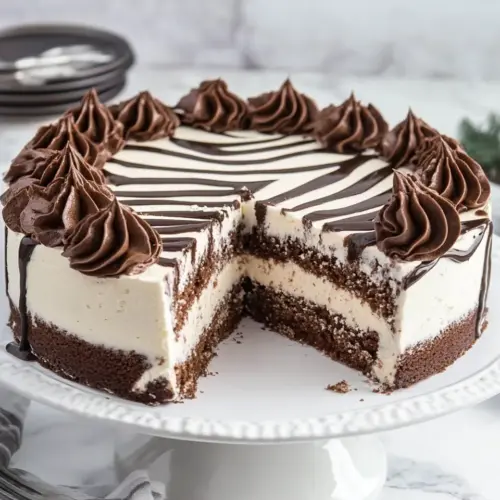
Zebra Cake Recipe
A chilled zebra cake with a chocolate cracker base and a two-tone meringue (plain and cocoa) set with gelatin for a striking striped effect.
Equipment
- springform pan (20 cm / 8 in)
- Parchment Paper
- Food Processor
- Microwave-safe Bowl
- Mixer
- Spatula
- Spoon
Ingredients
Ingredients
- 300 gchocolate graham crackers or European chocolate digestive biscuits
- 100 gcream cheese
- 10 ggelatin sheets
- 100 mlwater
- 5 egg whites from medium eggs
- 250 gcaster sugar
- 20 gcocoa powder
Instructions
Instructions
- Line a 20 cm (8 in) detached/springform cake pan with parchment paper.
- In a food processor, crush the 300 g chocolate graham crackers until fine. Transfer the crumbs to a large bowl, add the 100 g cream cheese, and mix by hand until the mixture is smooth and homogeneous.
- Press the crumb mixture evenly and firmly into the bottom of the prepared pan to form a base. Set the pan aside.
- Place 100 ml cold water in a small microwave-safe bowl and add the 10 g gelatin sheets. Let the sheets soak in the water until soft (about 5 minutes).
- Microwave the bowl for a few seconds, then stir until the gelatin is fully dissolved and the liquid is clear. Let the gelatin cool briefly until it is lukewarm but still liquid.
- In a clean mixer bowl, whisk the 5 egg whites on medium–high speed until foamy and soft peaks form. Add the 250 g caster sugar in batches, continuing to beat until the whites are glossy and hold stiff peaks.
- With the mixer on low, pour the lukewarm dissolved gelatin into the meringue in a thin steady stream and mix briefly to combine.
- Spoon half of the meringue mixture evenly over the prepared cracker base and smooth the surface. Add the 20 g cocoa powder to the remaining meringue and fold gently with a spatula until evenly combined and uniformly brown. Pour the cocoa mixture over the white layer in the pan. Use a spoon to gently swirl or streak the two layers to create a zebra effect — do not overmix.
- Refrigerate the cake for 4 hours, or until set. Once chilled and firm, unmold the cake and serve.
Notes
Notes
Make sure the water for the gelatin is not too warm so as not to burn the gelatin!
Make sure the water for the gelatin is not too warm so as not to burn the gelatin!